Golf ball with a urethane cover using mixed cyclohexane dimethanol extenders
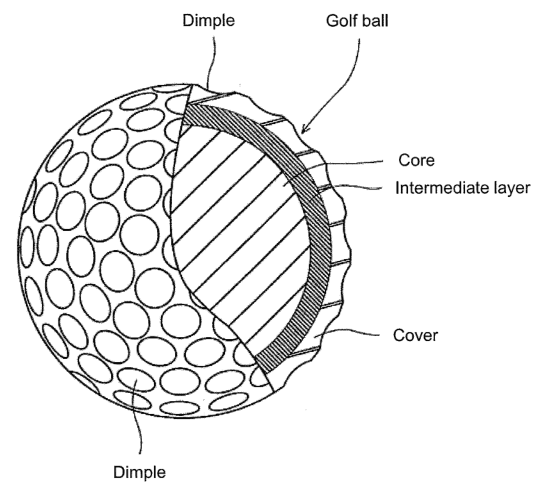
A multi-piece golf ball with a core and a polyurethane cover whose chain extender is a specific mix of cis‑1,4‑cyclohexane dimethanol and trans‑1,4‑cyclohexane dimethanol. The formulation was intended to give a relatively soft urethane cover (Shore D 20, 48) that improves spin and shot feel while keeping abrasion resistance, aimed at golfers who want more short‑game control than typical ionomer covers provide.
(57) What the patent covered
The main independent claim requires a golf ball having a core and a polyurethane cover where the polyurethane is a straight‑chain polymer made from (1) a polyisocyanate, (2) a high‑molecular‑weight polyol, and (3) a chain extender that is a mixture of cis‑1,4‑cyclohexane dimethanol and trans‑1,4‑cyclohexane dimethanol, and the cover must have a Shore D hardness between 20 and 48. A dependent independent claim further limits the cis/trans mass ratio to 10/90, 70/30.
The distinctive part: Using a specified mixture ratio of cis and trans isomers of 1,4‑cyclohexane dimethanol as the chain extender in a straight‑chain polyurethane cover and targeting a Shore D hardness of 20, 48.
Novelty 3/5. Polyurethane covers for balls were already known; the patent’s novelty is a particular chain‑extender composition (cis/trans mix) and hardness window to balance spin, feel and abrasion resistance, rather than a wholly new class of cover.
Making it
Likely made by preparing a prepolymer from polyisocyanate and high‑molecular‑weight polyol, then chain‑extending with the cis/trans CHDM mix to form a straight‑chain polyurethane; standard molding (injection or cast) to form the cover, followed by curing and assembly over the core.
Materials: polyurethane (polyisocyanate + high‑MW polyol), cis‑1,4‑cyclohexane dimethanol, trans‑1,4‑cyclohexane dimethanol, core materials likely rubber or ionomer (not specified)
Manufacturability 4/5. Typical polyurethane cover production: prepolymer synthesis and a chain‑extension step require chemical handling and controlled curing but use common elastomer processing equipment; part count is low and final molding/assembly is straightforward.
Is anyone buying?
Comparable products are on sale; this exact design wasn't found. Typical retail price: $57–$58. Premium urethane-ball models with tour-level spin and soft feel are actively marketed by major brands; multiple retailers list TP5 and Chrome Soft variants with pricing around $57.99 per dozen.
- Callaway Chrome Soft (2026) golf balls · Callaway Golf / official retailers (e.g., Callaway.com, PGA TOUR Superstore, Dick's Sporting Goods)$57.99 per dozen
- TaylorMade TP5 (2026) golf balls · TaylorMade / retailers (e.g., TaylorMade official site, PGA TOUR Superstore, Dick's Sporting Goods)$57.99 per dozen
This demand check was run with a web search in the week of Oct 5, 2026. Listings change often, so treat it as a starting point for your own research.
Who buys it: amateur and skilled golfers seeking better short‑game spin and softer feel
Sourcing
Factories already list this kind of product on supplier marketplaces, at about $0.40–$0.80 per unit with minimum orders around 1,000 units. Against the typical retail price, that factory cost is roughly 1–1% of the shelf price before shipping, duties and marketplace fees. These listings show USGA-conforming urethane/surlyn multi-layer golf balls with customizable branding; exact formulations (including cis/trans cyclohexane dimethanol chain extenders) are described in related patents, but the supplier listings themselves do not provide the chemical formulation details.
- JTS (Xiamen) Sports Equipment Co., Ltd. · Alibaba.com (USGA Conforming Custom Golf Balls 2/3/4 Layers High Quality Surlyn/urethane Golf Balls) · MOQ 500$0.80 (500-2,999 pcs); $0.60 (3,000-5,999 pcs); $0.42 (6,000-11,999 pcs); $0.40 (12,000+ pcs)
- Wuday Golf Ball (Custom Logo 3-Piece Urethane Golf Balls) · Alibaba.com · MOQ 300$0.62 (300-599 pcs); $0.55 (600-1199 pcs); $0.45 (>=1200 pcs)
Supplier prices come from public listings found with a web search and are usually quoted before customization, shipping and duties, so use them to judge whether a product is worth a quote request.
Before you make it
We didn't find any related continuation or divisional patents still in force, although that doesn't rule out design patents, trademarks or unrelated patents covering the same product.
Patent lapsed, but the formulation relies on specific isomer ratios and controlled polyurethane chemistry, so manufacturing needs chemical handling and consistent curing; quality control for hardness and abrasion resistance is important.
Owners occasionally revive lapsed patents (about 1.5% are), and this page is a research lead rather than legal advice, so get a freedom-to-operate opinion before you manufacture anything.