Eyeglass frame with hinge that folds out ~180°
A spectacle frame whose hinge assembly lets the temple rotate outward to about 180 degrees for extra flex and comfort. The hinge uses a frame joint with a pin seat and tenon and a temple joint with a stem ending in a U-shaped fork, with a pin through the fork and a bore and an elastic member between them; wearers who need looser temples (everyday eyeglass users) benefit. The patent lapsed, so this describes the disclosed hardware, not legal advice.
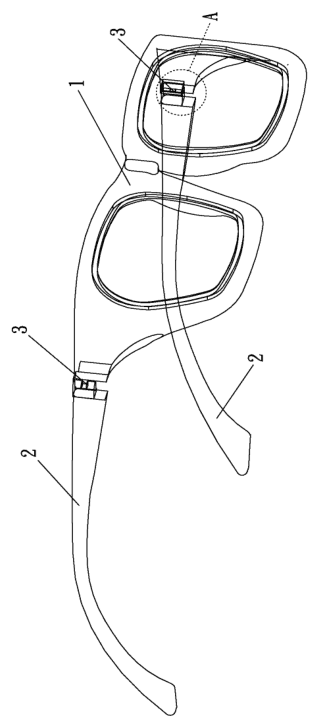
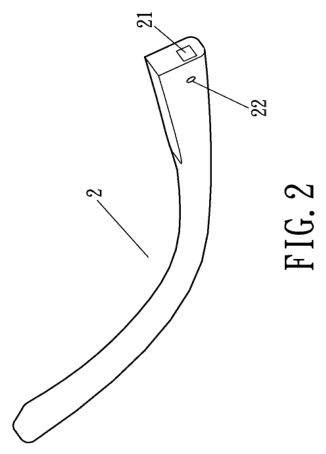
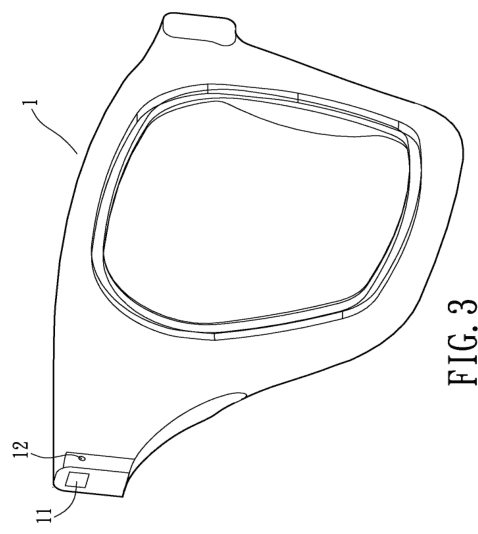
(57) What the patent covered
The main independent claim covers a three-part hinge: a frame piece with a tenon receiving hole and a perpendicular frame screw hole; a temple piece with a stem receiving hole and a perpendicular temple screw hole; and a hinge comprising a frame joint with a pin seat (through bore) and tenon (tenon screw hole), and a temple joint with a stem (stem screw hole on its side) ending in a substantially U-shaped fork with a channel through both fork branches. A pin passes through the channel and bore, and the stem/tenon are fastened by screws; an elastic member is described as retained in the stem and abuts the pin seat.
The distinctive part: The U-shaped forked temple joint with a channel for a pin combined with a tenon/pin seat arrangement that permits about 180° outward rotation and uses an internal elastic member for preload.
Novelty 3/5. This is a clever mechanical improvement on familiar spring and barrel hinges: flexible hinges and spring-loaded hinges were common, but the forked-stem plus pin-seat arrangement for large outward rotation was a different hinge geometry.
Making it
Likely injection-molded plastic or stamped/die-cast metal for frame/temple pieces, stamped or machined steel pins and screws, insertion of an elastomer or spring into the stem, then assembly by screwing the stem/tenon into the temple/frame and pressing the pin through the fork and bore.
Materials: injection-moldable plastic (acetate, TR-90), stainless or plated steel pin/screws, small elastomer or spring (rubber or metal spring), possibly die-cast or stamped metal hinge parts
Manufacturability 4/5. Requires several molded or stamped parts plus small metal fasteners and an elastic element; assembly is straightforward but needs correct orientation and insertion of the pin and screw, typical eyewear supply chain and lines can handle it.
Is anyone buying?
This design, or something very close to it, is on sale now. Typical retail price: $7–$89. Zenni lists a frame with a 180-degree full swing spring-loaded hinge; ZanyLen offers an 180° flex hinge frame with clip-ons (US warehouse shipping, 365-day guarantee).
- Oval Glasses 381815 · Zenni Optical$6.95
This demand check was run with a web search in the week of Sep 21, 2026. Listings change often, so treat it as a starting point for your own research.
Who buys it: eyeglass wearers wanting looser, flexible temples; eyewear brands and replacement-frame buyers
Before you make it
We didn't find any related continuation or divisional patents still in force, although that doesn't rule out design patents, trademarks or unrelated patents covering the same product.
Practical issues include small-part sourcing (pins, screws, springs/elastomers), tolerance control so the hinge pivots smoothly without wobble, and crowded hinge designs in the market; the patent text is specific about geometry but vaguely specifies the elastic member, so performance depends on choice of spring/elastic.
Owners occasionally revive lapsed patents (about 1.5% are), and this page is a research lead rather than legal advice, so get a freedom-to-operate opinion before you manufacture anything.