Leakage-reduction capacitor network for AC-to-DC power adapters
A circuit for two-stage AC-to-DC power adapters that routes common-mode noise from the isolated secondary back to the primary while limiting dangerous high-voltage leakage onto the low-voltage output. It uses two safety (Y) capacitors tied from secondary ground to primary ground and to AC neutral, plus an X-capacitor across line and neutral. Intended for wall adapters and similar supplies used with mobile or computing devices.
(57) What the patent covered
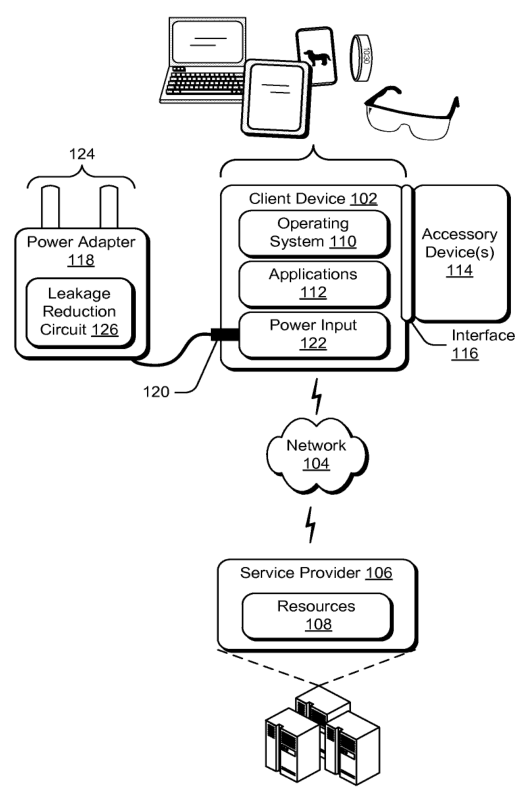
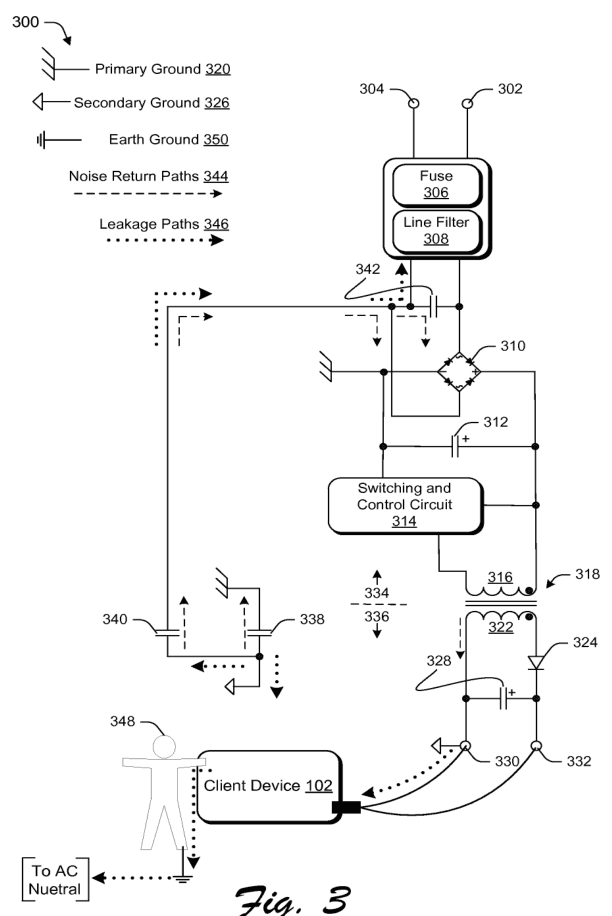
The main independent claim covered a power adapter having a primary (mains) side and an isolated secondary side, plus a leakage-reduction network that includes: (1) a first Y-capacitor between the secondary ground and the primary ground, (2) a second Y-capacitor between the secondary ground and AC neutral that sets the secondary ground to zero volts relative to neutral, the two Y-capacitors having the same nominal capacitance, and (3) an X-capacitor between AC neutral and AC line.
The distinctive part: Requiring two Y-capacitors of the same nominal capacitance, one tied to primary ground and one to AC neutral, so the secondary ground is forced to neutral potential while providing a controlled noise-return path.
Novelty 3/5. At filing time, Y-caps and X-caps in adapters were common for EMI and safety; the claimed step is a particular arrangement and matching of two Y-capacitors to tie secondary ground to neutral rather than only to earth/primary ground.
Making it
PCB-mounted components with wave- or reflow-soldered safety capacitors, winding/assembly of the power conversion transformer or SMPS stage, and final hand or machine assembly and test of the adapter enclosure.
Materials: Class-Y safety capacitors (metallized polypropylene or ceramic Y2/Y1 rated), Class-X safety capacitor (metallized polypropylene X2 rated), FR-4 PCB substrate, standard transformer/SMPS components (ferrite, windings)
Manufacturability 4/5. Uses common off-the-shelf safety capacitors and standard PCB assembly; requires sourcing certified X/Y safety caps and basic insulation/creepage design but no exotic tooling.
Is anyone buying?
Comparable products are on sale; this exact design wasn't found. Suppliers widely discuss line-to-line (X) and line-to-ground (Y) capacitor networks and common-mode EMI filtering used in AC-DC adapters; many listings emphasize safety-class components and filter design kits.
- EMI Filter Design Kit (DESIGNKIT_744998) · Würth Elektronik (WE-Online)
- EMI Filter Components - Y-capacitors and safety-rated capacitors · Bel Fuse
- EMI Filter for SMPS Adapters - 90V to 264V, X/Y capacitors · Vishay
This demand check was run with a web search in the week of Oct 5, 2026. Listings change often, so treat it as a starting point for your own research.
Who buys it: electrical designers for wall chargers and OEMs of mobile device power supplies
Sourcing
Factories list related products that could likely be adapted, at about $0.01–$0.36 per unit with minimum orders around 1 units. Listings are for individual safety Y capacitors (and related EMI components) commonly used in AC mains EMI filters; manufacturers can typically do OEM/private-label of capacitor networks but a direct, ready-made two-Y-capacitor + X-capacitor network module specifically integrated for wall adapters is not clearly listed as a pre-packaged product on these pages. Custom assembly or private-labeling of EMI filter networks may be possible.
- Shenzhen Jinhongyang Technology Co., Ltd. · Alibaba.com · MOQ 10.10-0.36
- Shenzhen Cxcw Electronic Co., Ltd. · Alibaba.com · MOQ 1000.01-0.10
- Wuhan Amsemi Tech Co., Ltd. · Alibaba.com · MOQ 100.15-0.20
Supplier prices come from public listings found with a web search and are usually quoted before customization, shipping and duties, so use them to judge whether a product is worth a quote request.
Before you make it
We didn't find any related continuation or divisional patents still in force, although that doesn't rule out design patents, trademarks or unrelated patents covering the same product.
Practical issues include meeting regional safety and leakage certification (e.g., IEC/UL limits) and sourcing safety-rated X/Y capacitors; the claim is narrowly about that capacitor arrangement rather than broader EMI techniques.
Owners occasionally revive lapsed patents (about 1.5% are), and this page is a research lead rather than legal advice, so get a freedom-to-operate opinion before you manufacture anything.