Power management system that estimates per-outlet usage from total meter plus per-outlet current sensors
A system for homes or small buildings that combines a single total power meter with current sensors on individual outlets to estimate each outlet’s power use. Current-sensing outlet modules transmit measured currents to a central controller, which reconciles the sum of per-outlet measurements with the total meter reading to compute per-device power and to infer appliance type from current signatures. Installers, energy managers and device makers would use it for monitoring and basic control of legacy appliances that lack smart interfaces.
(57) What the patent covered
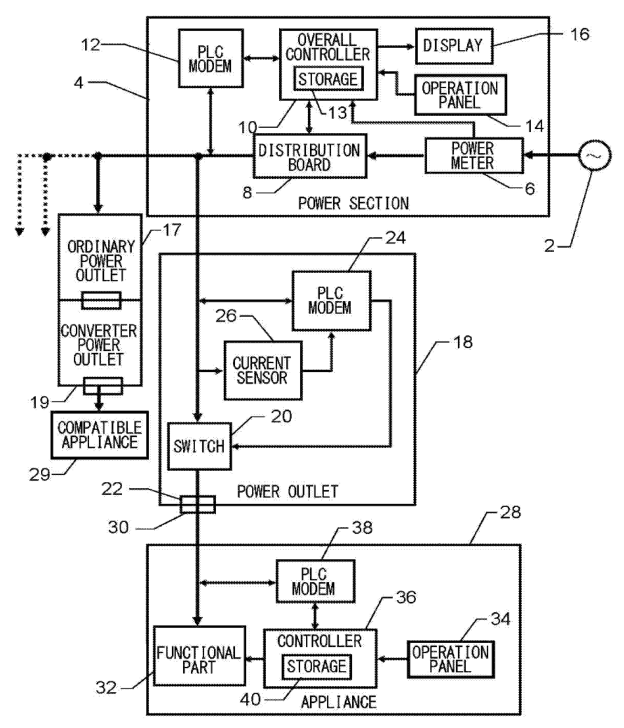
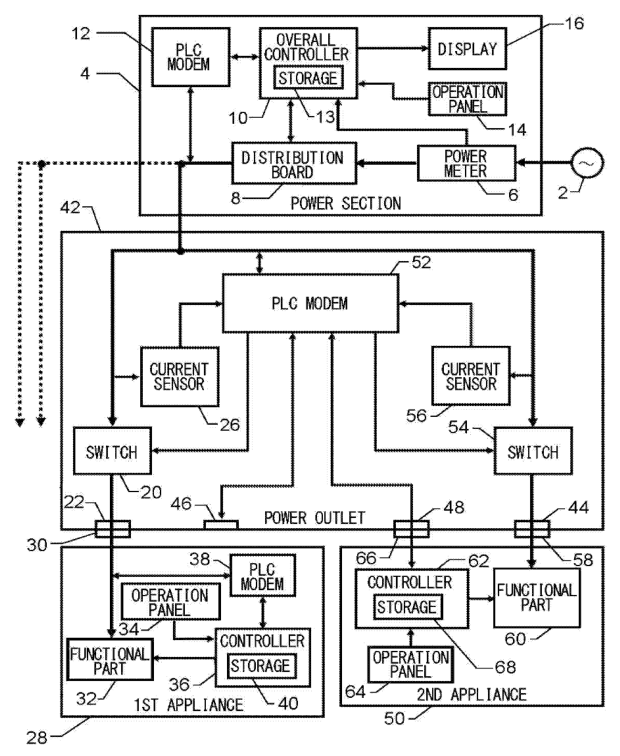
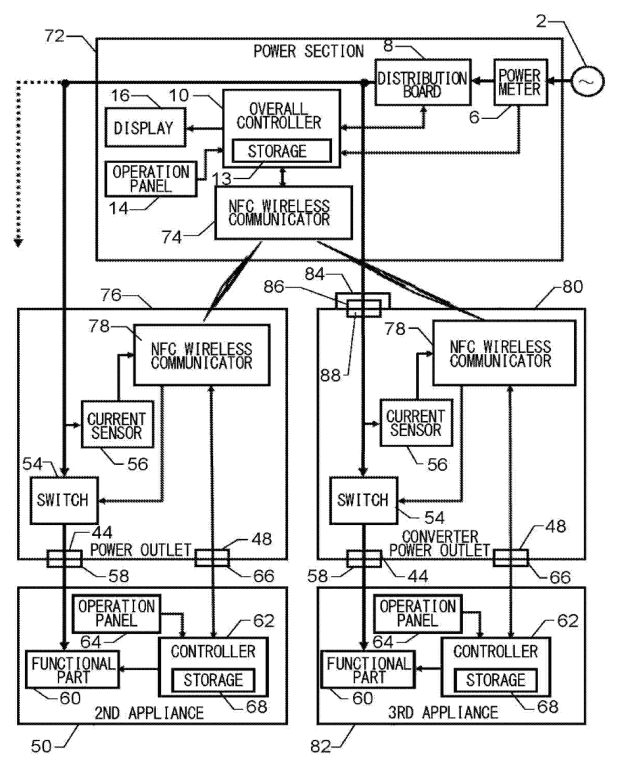
The main independent claim covered a power-supply, a total power meter, multiple current sensors each measuring the current to a respective power consumer, and a controller that computes each consumer’s power consumption using the per-outlet current sensor readings together with the total power measured by the single power meter (the total meter does not separately measure each consumer). A dependent independent claim covered inferring the kind of appliance at each outlet from the detected current waveforms without prior labeling.
The distinctive part: Combining a single whole-site power meter with distributed per-outlet current sensors and using both sets of data in a controller to calculate per-outlet power and infer appliance type.
Novelty 3/5. At filing time distributed metering and outlet modules existed, but this patent emphasized using a total-meter-plus-current-sensor reconciliation and current-pattern inference to estimate per-outlet power for non-smart loads, which is a clever improvement on familiar metering setups.
Making it
Injection-molded plastic housing, PCB assembly with soldered components, snap-fit or screw-mount current sensor (ferrite core or shunt), firmware programming, and final functional test and labeling.
Materials: ABS or polycarbonate plastic outlet housing, CT or shunt-based current sensor (e.g., ferrite-core CT), Low-power microcontroller and RF/Wired comms module (BLE/Zigbee/Wi‑Fi), Printed circuit board with passive components
Manufacturability 4/5. Typical parts and processes: one molded housing, a PCB with sensors and comms, and modest hand or machine assembly; no exotic tooling but accurate sensor calibration and EMC testing required.
Is anyone buying?
This design, or something very close to it, is on sale now. Multiple listings emphasize outlet-level (per-receptacle) monitoring, SNMP/web access, and networked data for load attribution; some are rack/PDU style, others are submeter kits for panels.
- Switched Metered PDU (SPDU) - 6/14 outlets · XPCC (Xtreme Power Components)
- MDTSW-2SC VerifEye Mini Meter Kit (submeter with CTs) · Leviton (VerifEye Mini Meter line)
- Branch Circuit Power Monitor (3-phase with remote CT modules) · Cambridge Logic
This demand check was run with a web search in the week of Oct 5, 2026. Listings change often, so treat it as a starting point for your own research.
Who buys it: electricians, energy-conscious homeowners, small building managers
Sourcing
Factories list related products that could likely be adapted, at about $2.90–$7.40 per unit with minimum orders around 50 units. There are commercially available smart-plug style energy monitors (per-outlet monitoring) on supplier marketplaces; these listings indicate energy-monitoring capabilities but are designed as consumer smart plugs rather than a modular per-outlet energy-monitoring system for a central controller. OEM/private-label and small-batch customization appear feasible, but the core product (a unified total-meter plus per-outlet sensing, with centralized reconciliation) is not clearly offered as a single, ready-made OEM solution in these listings.
- Ningbo Peacefair Electronic Technology Co., Ltd. · Alibaba.com · MOQ 100 pieces$2.90-$3.30
- XIAMEN LEELEN SMART TECHNOLOGY CO., LTD. · Alibaba.com · MOQ 1 set$7.20-$7.40
- Shenzhen Annaimu Electronic Co., Ltd. · Alibaba.com · MOQ 50+ pieces$7.20-$7.40
Supplier prices come from public listings found with a web search and are usually quoted before customization, shipping and duties, so use them to judge whether a product is worth a quote request.
Before you make it
We didn't find any related continuation or divisional patents still in force, although that doesn't rule out design patents, trademarks or unrelated patents covering the same product.
Practical issues include sensor accuracy and calibration, synchronization/latency between the total meter and outlet sensors, regulatory safety and EMC certification, and crowded market for smart outlets and power strips.
Owners occasionally revive lapsed patents (about 1.5% are), and this page is a research lead rather than legal advice, so get a freedom-to-operate opinion before you manufacture anything.