Per‑key touch gestures on a physical or virtual keyboard
The patent describes using position sensors on individual keys (or key images on a touchscreen) to detect where on a key a finger contacts and then interpreting small directional motions that start in a defined central null zone and move into one of several surrounding quadrants as modified input. That lets a single key represent multiple characters or actions depending on the on‑key gesture; intended users are keyboard manufacturers and device OEMs wanting richer input without adding keys.
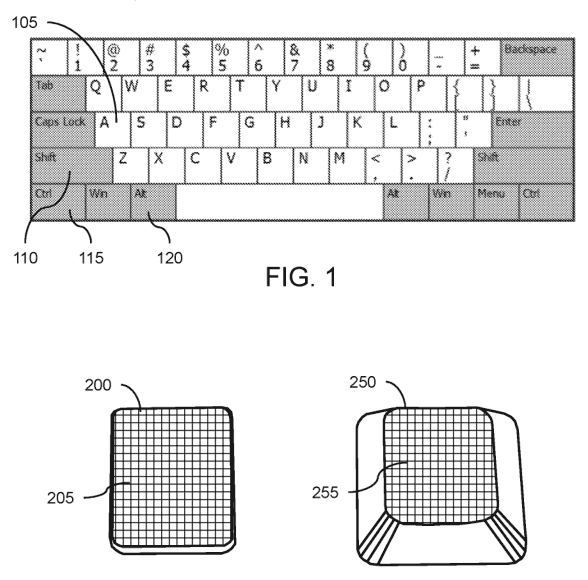
(57) What the patent covered
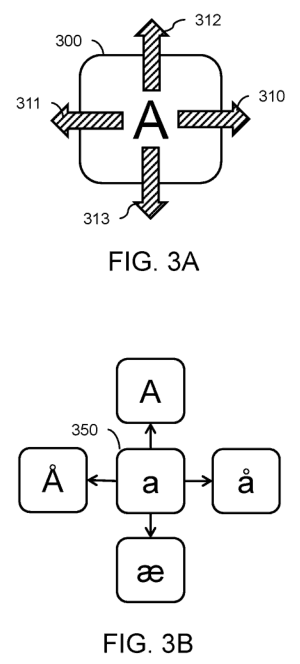
The independent claim covers receiving a contact on a keyboard key (physical or virtual) including the contact location, ignoring other simultaneous contacts, detecting a motion that begins in a fixed central null zone on that key and exits into one of several surrounding quadrants, and determining the resulting input as the key's base character modified according to which quadrant the motion ends in.
The distinctive part: Requiring the gesture to start in a statically defined central null zone on a single key and using the exit quadrant to pick a modified character or function.
Novelty 3/5. At filing time touch keyboards, chorded modifiers and swipe keyboards existed, but mapping short on‑key directional gestures that begin in a null center and end in quadrants to multiple characters per key was a clever improvement on familiar approaches.
Building it
A small team would add capacitive touch pads under each keycap (or use touchscreen coordinate input), sample contact location at 100, 1,000 Hz, implement a short state machine that detects contact, enforces the central null zone start, tracks the motion until it exits and classifies the exit quadrant, then emit the mapped character via the OS input API; provide calibration and sensitivity settings in firmware and a companion UI for key mappings.
Components: Physical keyboard with per‑key capacitive (or proximity) position sensors or a touchscreen virtual keyboard, Microcontroller/processor to sample sensor/touch coordinates and run gesture logic, Firmware/software implementing null zone, quadrant detection and key mapping, Host OS driver or input‑method hook to translate gesture results into characters/actions
Buildability 5/5. Engineering is straightforward with common sensors and input APIs; the harder parts are tuning sensor layout, debounce/false‑positive filtering and UX (null zone size, timing) across hand sizes.
Is anyone buying?
Products offering this capability exist today. At least two real product efforts exist combining touch surfaces with per-key interaction (CLVX 1 and Keytouch concepts); consumer availability is limited and pricing not publicly listed.
- Clevetura CLVX 1 Wireless Keyboard · Clevetura (retailers and resellers; product page coverage via Tom's Hardware review)not listed
- Key Pointer / Directional Touch Micro Keyboard · Keytouch Technologies (Keytouch Technologies LLC)not listed
This demand check was run with a web search in the week of Oct 5, 2026. Listings change often, so treat it as a starting point for your own research.
Who buys it: keyboard OEMs, laptop/tablet OEMs, virtual keyboard developers
Before you make it
We didn't find any related continuation or divisional patents still in force, although that doesn't rule out design patents, trademarks or unrelated patents covering the same product.
Practical risks are UX sensitivity (false gestures), a crowded field of virtual keyboard patents and product implementations, and the need for good calibration and accessibility options; this is a lapsed patent summary, not legal advice.
Owners occasionally revive lapsed patents (about 1.5% are), and this page is a research lead rather than legal advice, so get a freedom-to-operate opinion before you manufacture anything.