Hydraulic-actuated boat lift with pivoting dual frames
A watercraft lift that uses two pivoting movable frames and a piston-and-cylinder actuator arranged with the cylinder and rod attached to opposite movable-frame attachment points. Extending or retracting the rod moves the support member (bunks or cradle) between lowered and raised positions by changing the relative heights of the two attachment points. Intended users are marinas, dock builders and boat owners who mount lifts to fixed shore or piling frames.
(57) What the patent covered
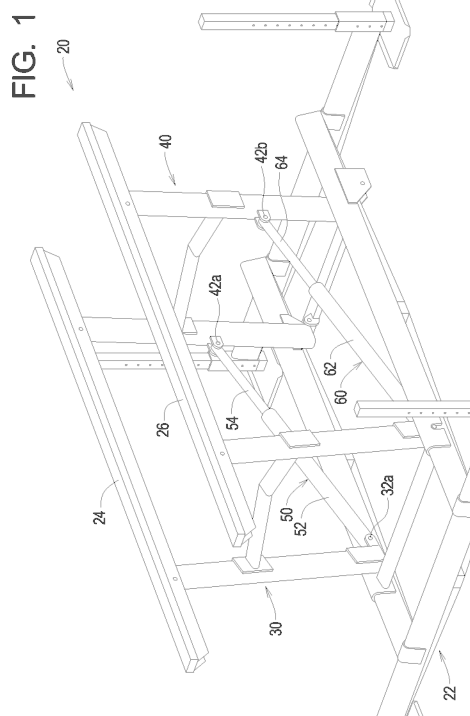
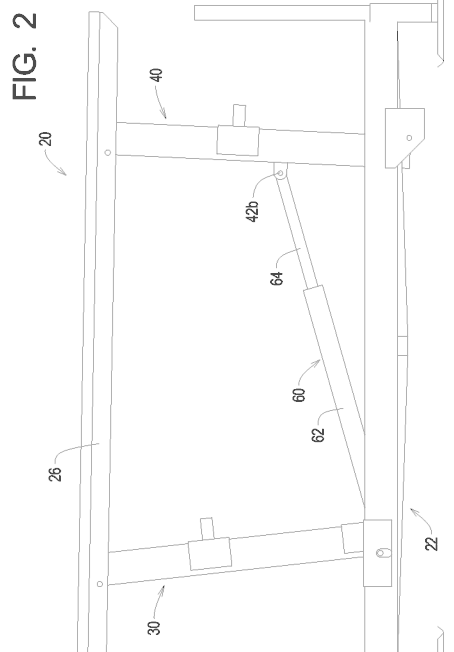
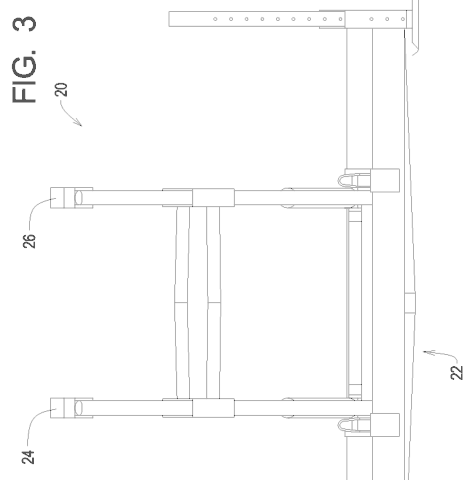
The main independent claim covers a fixed frame carrying two movable frames that each pivot on parallel lower axes, with the support member pivoting on upper axes, and with at least one actuator assembly whose cylinder is pivotably connected at one movable-frame attachment point and whose rod is pivotably connected at the other movable-frame attachment point; when the rod extends the support member is lowered and when it retracts the support is raised, and as the support moves the first attachment point passes below/above the plane defined by the lower axes.
The distinctive part: The actuator is a single cylinder/rod pair whose ends are pivoted to two separate movable-frame attachment points so that extending/retracting the rod changes the relative vertical position of those attachments and lifts the support via the linked frames.
Novelty 3/5. This is a clever kinematic arrangement rather than a wholly new kind of boat lift; boat lifts with pivoting arms and hydraulic cylinders were common, but this patent emphasizes the specific geometry of two movable frames and opposite pivot connections of cylinder and rod.
Making it
Welded steel fixed frame and movable arms from tube and plate, machined pivot bosses and welded brackets, off-the-shelf hydraulic cylinders assembled and pinned, bunk assemblies (timber or extruded aluminum with foam/rubber covering) bolted on; final assembly with pins, hydraulic fittings and testing.
Materials: steel tube frame (structural steel), stamped or welded steel brackets and arms, hydraulic cylinder with steel rod and seals, rubber or foam bunk covers (support members)
Manufacturability 4/5. Several welded and machined steel parts plus a hydraulic cylinder and pins; needs common fab shop tooling and moderate assembly but no exotic processes.
Is anyone buying?
Comparable products are on sale; this exact design wasn't found. Listings indicate hydraulic actuators driving two-frame lift configurations; multiple US retailers list two-cylinder hydraulic systems for PWC and boat lifts, with remote controls and cantilever/piling-mount variants; many listings do not publish exact prices online.
- 2K Dual Hydraulic PWC Lift · Paradise Dock & Lift
- Shoremate 8000 lb Cantilever Hydraulic Lift (L8000H) · Boat Lift & Dock
- Proteus Hydraulic Low-Profile Boat Lift (Overhead/ piling or dock mount) · Boat Lift & Dock
This demand check was run with a web search in the week of Oct 5, 2026. Listings change often, so treat it as a starting point for your own research.
Who buys it: marinas, dock contractors, boat owners with shore mounts
Sourcing
Factories already list this kind of product on supplier marketplaces. Listings exist for hydraulic boat lift frames/arms with pivoting features or similar assemblies; none publicly display explicit unit prices or MOQs. OEM/private-label customization is common in this sector (especially via Alibaba-type listings).
- Alibaba (Heavy Duty 50t Barge Watercraft Floating Boat Lift System) · Alibaba.com · MOQ not listednot listed
- Boat Lifts International · boatliftsintl.com · MOQ not listednot listed
- Aqua-Lift, Inc. · aqualiftinc.com · MOQ not listednot listed
Supplier prices come from public listings found with a web search and are usually quoted before customization, shipping and duties, so use them to judge whether a product is worth a quote request.
Before you make it
We didn't find any related continuation or divisional patents still in force, although that doesn't rule out design patents, trademarks or unrelated patents covering the same product.
Practical issues include corrosion protection for steel/hydraulics in a marine environment and ensuring pivot and cylinder sizing for boat weight; the patent focuses on kinematics and may be narrow in geometric detail.
Owners occasionally revive lapsed patents (about 1.5% are), and this page is a research lead rather than legal advice, so get a freedom-to-operate opinion before you manufacture anything.