Transmission mechanism for raising a stand in an endoscope insertion device
A mechanical transmission that converts user input at a proximal raising operation control into forward/back motion to lift a small raising stand that holds an insert object (treatment instrument or guide) on an endoscope. It uses a movable member coupled to an adjustable-length element (an expansion/contraction member), an elongated tensioned member (wire or rod) that pulls or presses the raising stand, and a regulation surface and support that limit changes in the adjustable member when tension is applied. Intended users are endoscope manufacturers and service engineers assembling or repairing endoscope accessories.
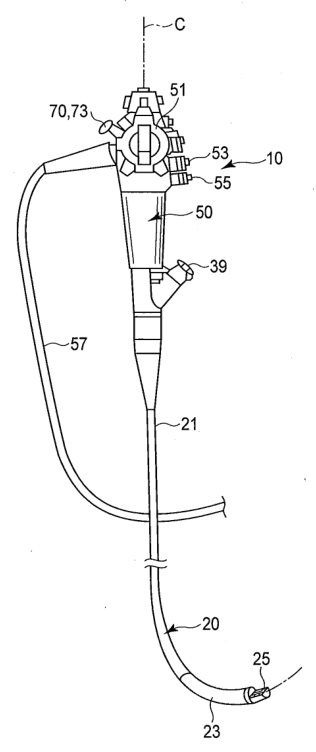
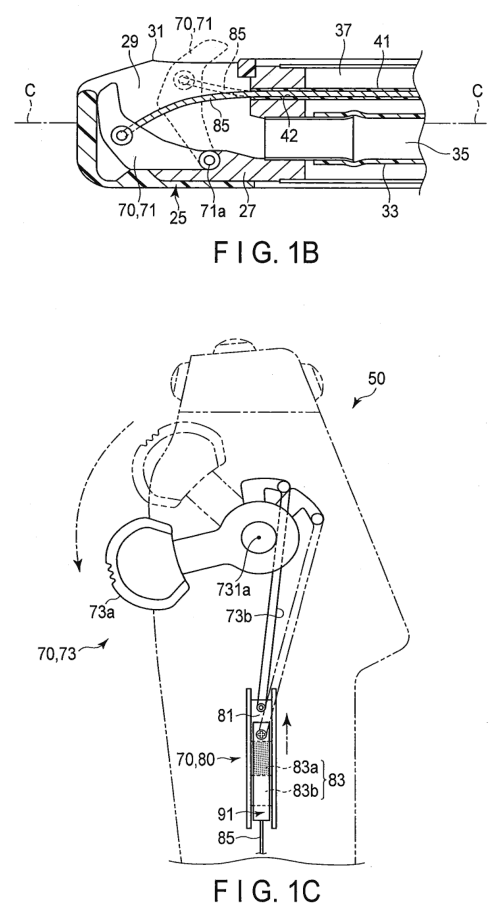
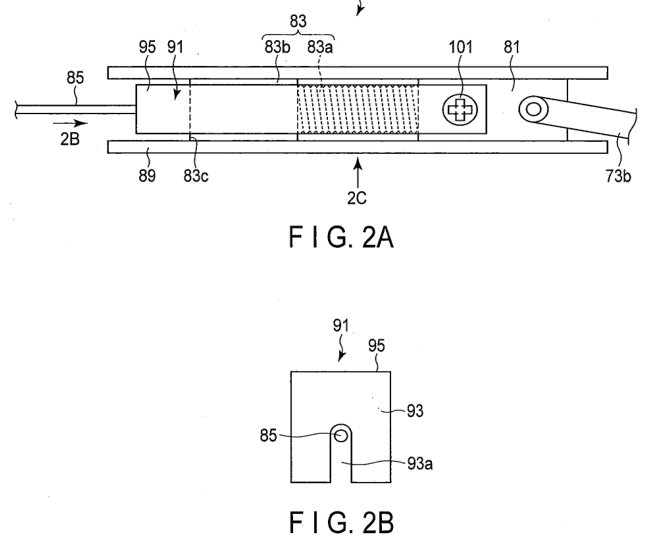
(57) What the patent covered
The main claim covers a transmission assembly that includes: a movable member that slides axially under operation; an adjustment unit coupled to that movable member which contains an element whose axial length can expand or contract; an elongated member (tensioned cable/rod) coupling the adjustment unit to the raising stand so it pulls or presses the stand; a regulation surface that contacts the adjustment unit; and a support carried by the movable member that positions and moves the regulation surface to restrict changes in the adjustable element's length when the raising control is operated and tension is present.
The distinctive part: The patent adds an integrated regulation surface and support moved by the same sliding member so the adjustable-length element is actively restrained when tension from a mounted, stiff insert object would otherwise cause excessive change.
Novelty 3/5. Adjustable-length connectors (coil springs, slack take-up) and wire-actuated raising stands were already used in endoscopes; this patent mainly combines a sliding support/regulator that limits expansion/contraction under load, a practical improvement rather than a brand new mechanism.
Making it
Injection-molded polymer slider, stamped or machined steel support and regulation plate, wound steel coil spring or telescoping rod as expansion/contraction element, wire-rope or stainless actuation cable; subassemblies crimped/riveted and hand-assembled into the insertion apparatus.
Materials: stamped or machined stainless steel (wires, supports, regulation surface), coil spring or telescoping metal/plastic rod (expansion/contraction member), polymer slider/movable member (POM, nylon), small fasteners or rivets
Manufacturability 4/5. Parts are standard: molded sliders, stamped/machined metal plates, springs and cables; assembly requires alignment and retaining features but no custom electronics, so typical small-medical device suppliers can produce it.
Is anyone buying?
We haven't run a demand check on this one yet. Shoppers would likely search for endoscope raise mechanism, instrument raising stand cable spring, endoscope slider regulator for raising arm; the links on the right open those searches.
Who buys it: endoscope OEMs, repair shops, surgical device integrators
Before you make it
We didn't find any related continuation or divisional patents still in force, although that doesn't rule out design patents, trademarks or unrelated patents covering the same product.
Practical issues include medical-device regulatory requirements (biocompatibility/cleanability, IEC 60601 where applicable), crowded prior-art space for endoscope mechanisms, and the lapsed patent may still reference other live patents; this summary is informational, not legal advice.
Owners occasionally revive lapsed patents (about 1.5% are), and this page is a research lead rather than legal advice, so get a freedom-to-operate opinion before you manufacture anything.