Paint brush with a recessed pivoting hanger rod
A paint brush whose handle contains a recessed groove holding a multi-segment hanger rod that pivots out to hook over a paint-can rim and pivots back flush into the handle. Painters who need to temporarily stow brushes on a can while changing colors or resting the brush are the intended users. The rod is held by a plate over the first rod segment so that the rod pivots within the groove and stays recessed when not in use.
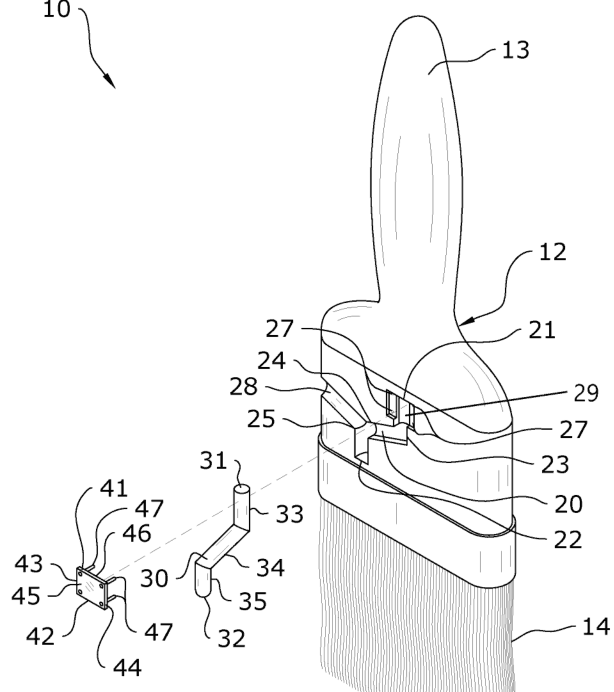
(57) What the patent covered
The independent claim covers a brush whose body has a three‑segment groove and a matching three‑segment hanger rod pivotally mounted inside that groove, with a plate fixed over the first groove/rod segment so the first rod segment pivots within the first groove segment; the hanger rod can be extended to engage (hook over) a rim (for example a paint‑can rim) and retracted to sit entirely within the groove.
The distinctive part: A multi‑segment, pivoting hanger rod recessed into a three‑segment groove in the brush handle with a plate securing the pivot point so the rod can fold flush into the handle.
Novelty 3/5. This is a clever improvement on familiar brush hooks and hanging notches, hanging brushes on can rims was common, but embedding a multi‑segment pivoting rod that folds fully into a recessed groove was not widespread when filed.
Making it
Injection‑mold the brush handle with a recessed multi‑segment groove, form the hanger rod by bending/blanking and plating steel, stamp or form a small plate to secure the pivot, then assemble by placing the rod into the groove and fastening the plate (likely with screws, rivets, or ultrasonic welding) and final assembly of bristles/ferrule.
Materials: injection‑molded plastic handle (e.g. polypropylene or ABS), stainless or plated steel rod for the hanger, stamped or molded metal/plastic plate for the pivot retention, bristles (natural or synthetic), adhesive or ferrule metal (if a traditional brush ferrule is present)
Manufacturability 4/5. Requires an injection‑molded handle with internal geometry and a small number of simple metal parts; assembly is straightforward but needs alignment of the rod and plate and securing (rivet/screw/weld).
Is anyone buying?
Comparable products are on sale; this exact design wasn't found. Typical retail price: $9–$10. Commonly stocked by retailers as a brush with an integrated hanging hook; includes volume pricing.
- 2-1/2” Wooster 5301 Hook & Hold Angle Wall and Trim Paint Brush,... · Paint Supply$10.02
This demand check was run with a web search in the week of Sep 28, 2026. Listings change often, so treat it as a starting point for your own research.
Who buys it: painters, DIYers who change brushes frequently
Before you make it
We didn't find any related continuation or divisional patents still in force, although that doesn't rule out design patents, trademarks or unrelated patents covering the same product.
Practical issues include wear/corrosion of the rod, tolerance fit so the rod pivots but stays recessed, and a crowded market of simple brush hooks; also claim language is fairly specific to a three‑segment groove/rod and plate pivot arrangement.
Owners occasionally revive lapsed patents (about 1.5% are), and this page is a research lead rather than legal advice, so get a freedom-to-operate opinion before you manufacture anything.