A table tennis racket with the handle set at an angle to the blade
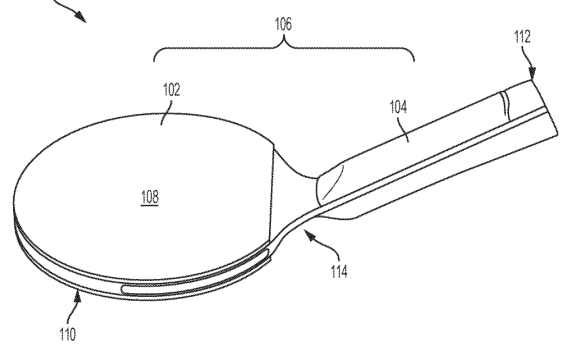
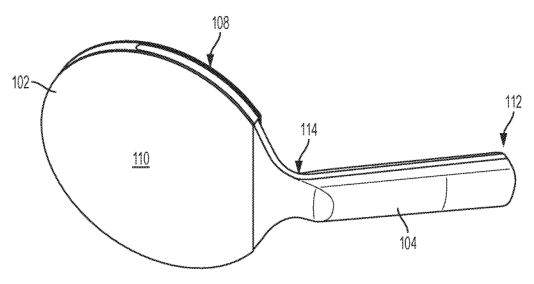
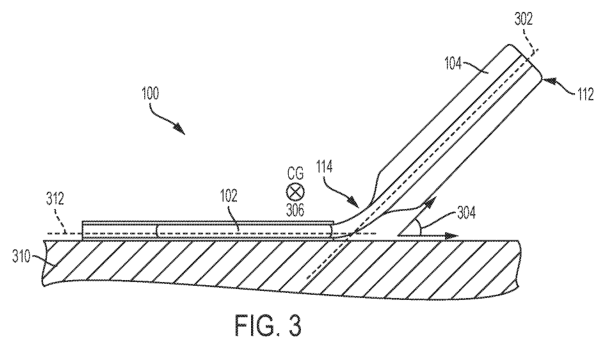
This is a hand racket whose handle axis is deliberately tilted relative to the flat blade so the whole body is non‑planar and asymmetrical. The handle is straight (linear) but joins the blade at an offset angle so part of the blade intersects the handle axis; the designer says that the unbalanced geometry is meant to allow higher spin. Players who want extreme spin or experimental gear would be the intended users.
(57) What the patent covered
The main independent claim requires a racket blade lying in a blade plane with two faces for striking and a straight (linear) handle whose longitudinal axis runs from base to blade connection; the blade connection end is joined so the handle axis is at an offset angle to the blade plane, at least part of the blade intersects that handle axis, and the assembled racket is unbalanced about the handle axis.
The distinctive part: The handle is a straight piece that is intentionally joined to the blade at an angle so the assembled racket is non‑planar and unbalanced, rather than a conventional flat, symmetric paddle.
Novelty 3/5. Changing handle orientation to alter balance and spin is a clever modification to a familiar product; conventional rackets are flat and symmetric so the offset handle configuration was a distinct design choice rather than a wholly new category of sports equipment.
Making it
Likely made from a laminated blade substrate (wood veneers or composite) with the handle formed from or bonded to that substrate, rubber or sheet coverings applied to the blade faces, and adhesive bonding or mechanical fastening at the angled junction; typical woodworking or small‑scale composite layup and hand assembly.
Materials: plywood or laminated wood substrate, rubber or sponge racket faces (or sheeted coverings), wood, plastic, or composite handle core, adhesive or molded joint materials
Manufacturability 4/5. Requires a few formed parts and a specific angled joint; tooling is simple (presses, cutters, adhesive fixtures) but assembly needs jigs to hold the offset angle and to ensure consistent balance and finish.
Is anyone buying?
This design, or something very close to it, is on sale now. Typical retail price: $100–$165. angled-handle design explicitly marketed; both listings emphasize a non-standard grip/handle angle; HighPeak page shows a purchasable item in US; Butterfly page lists angled handle options and stock in the US; both are e-commerce listings with product details.
- Angled Ping Pong Paddle · HighPeak$99.56
- Outerforce ALC Blade · Butterfly (Outerforce Blade series)$164.99
This demand check was run with a web search in the week of Sep 21, 2026. Listings change often, so treat it as a starting point for your own research.
Who buys it: table tennis players seeking high‑spin or novelty paddles
Before you make it
We didn't find any related continuation or divisional patents still in force, although that doesn't rule out design patents, trademarks or unrelated patents covering the same product.
Practical risks are player discomfort or control issues from the unbalanced shape and the product may be a niche item in a crowded paddle market; patent has lapsed so no enforcement concern but ergonomics and acceptance are the main barriers.
Owners occasionally revive lapsed patents (about 1.5% are), and this page is a research lead rather than legal advice, so get a freedom-to-operate opinion before you manufacture anything.