Toolbox buckle with dual torque springs and linked lever rods
A mechanical latch assembly for a toolbox cover that uses a connector with two transverse levers whose rods engage bores in a separate buckle, plus an elastic element made from two torsion (torque) springs and an intermediate lever. The springs bias both the buckle relative to the connector and the connector relative to the toolbox so the latch holds closed and returns to a ready position; users are toolbox makers and people assembling small portable toolboxes.
(57) What the patent covered
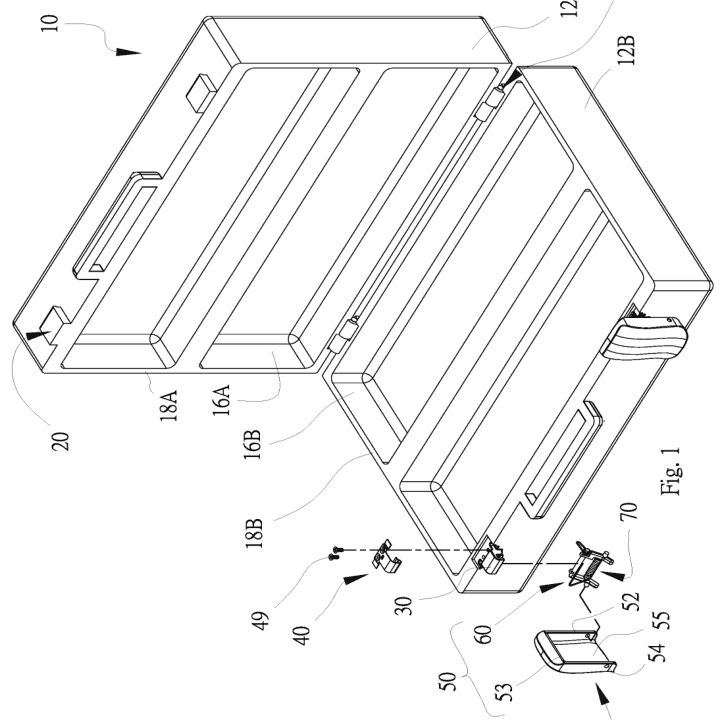
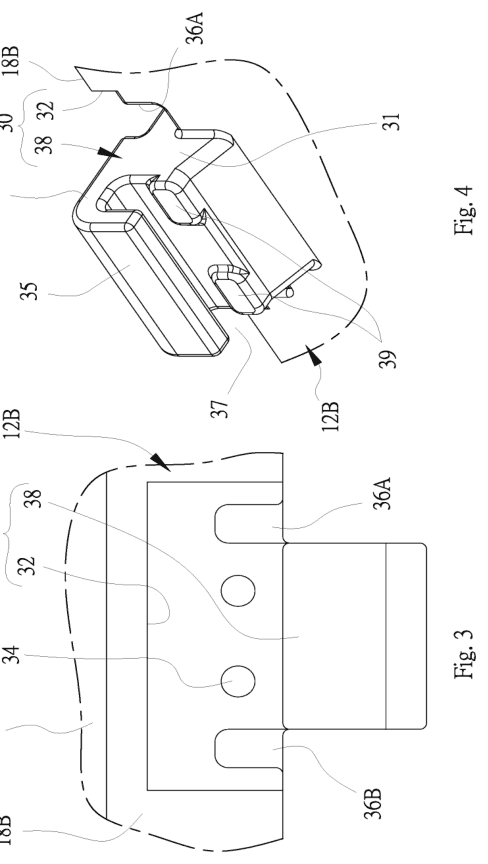
The independent claim covers a buckle that has two bores and a connector mounted to the toolbox with a main axle and two transverse levers; each lever carries an external rod that projects into a corresponding bore in the buckle. An elastic element made of a first torque spring, a second torque spring, and an intermediate lever is arranged so the first spring sits between and connects the two levers to bias the buckle away from the connector, the second spring is supported on one lever to bias the connector away from the toolbox, and the intermediate lever abuts the first lever.
The distinctive part: Combining two torsion springs plus an intermediate lever into one elastic element that provides separate biasing actions on both the buckle and the connector.
Novelty 3/5. This is a clever mechanical improvement on standard toolbox latches (which commonly use a single torsion spring or a straightforward pivoting buckle); it’s a focused improvement rather than a wholly new class of product.
Making it
Stamped or machined steel parts for the connector and rods, wound torsion-spring manufacture, injection-molded plastic buckle body, assembly by inserting rods into buckle bores and fitting springs on axles, then riveting or press-fitting the main axle.
Materials: stamped or cast steel for levers/rods/main axle, mild steel torsion springs (spring wire), injection-molded ABS or polypropylene for the buckle body (likely), small fasteners or rivets (steel)
Manufacturability 4/5. Requires several stamped/machined metal parts and two formed torsion springs plus assembly to align rods and bores; conventional metal stamping and springmaking shops plus basic molding for any plastic buckle suffice.
Is anyone buying?
Comparable products are on sale; this exact design wasn't found. High-volume hardware seller with hundreds of toggle latches; listing shows multiple material/tension options and a large number of positive feedbacks.
- Spring Loaded Toggle Latch Catch 201/304 Stainless Steel Buckle... · GBWS-baiguojing (eBay store)US $5.13
This demand check was run with a web search in the week of Sep 7, 2026. Listings change often, so treat it as a starting point for your own research.
Who buys it: toolbox manufacturers and small tool storage makers
Before you make it
We didn't find any related continuation or divisional patents still in force, although that doesn't rule out design patents, trademarks or unrelated patents covering the same product.
Practical risks are mainly mechanical: tolerance fit of rods and bores and spring preload matter; claims are specific to this spring-and-lever arrangement so the protection was narrow and has lapsed.
Owners occasionally revive lapsed patents (about 1.5% are), and this page is a research lead rather than legal advice, so get a freedom-to-operate opinion before you manufacture anything.